
UBE Recycling, WBE Dosing to DTDC
Used Bleaching Earth safely and accurately dosed into the DTDC of solvent extraction plants, turning a disposal problem into economic value.
From Disposal Problem to Resource
Bleaching earth is used as an adsorbent in vegetable oil refining to protect oil quality and remove color. After use, plants are left with large quantities of Used Bleaching Earth (UBE/WBE), a waste stream that creates disposal costs, environmental concerns and handling challenges.
Save Tech's answer: instead of paying for disposal, the material is safely integrated into the DTDC (Desolventizer Toaster Dryer Cooler) during soybean meal production, under carefully controlled operating conditions, with no major additional equipment required. A genuine circular-economy solution.
- Generated after oil refining, used as adsorbent in the process
- Replaces a portion of fresh bleaching earth economics
- Eliminates landfill disposal and its costs
- Lowers the plant's carbon footprint and waste generation
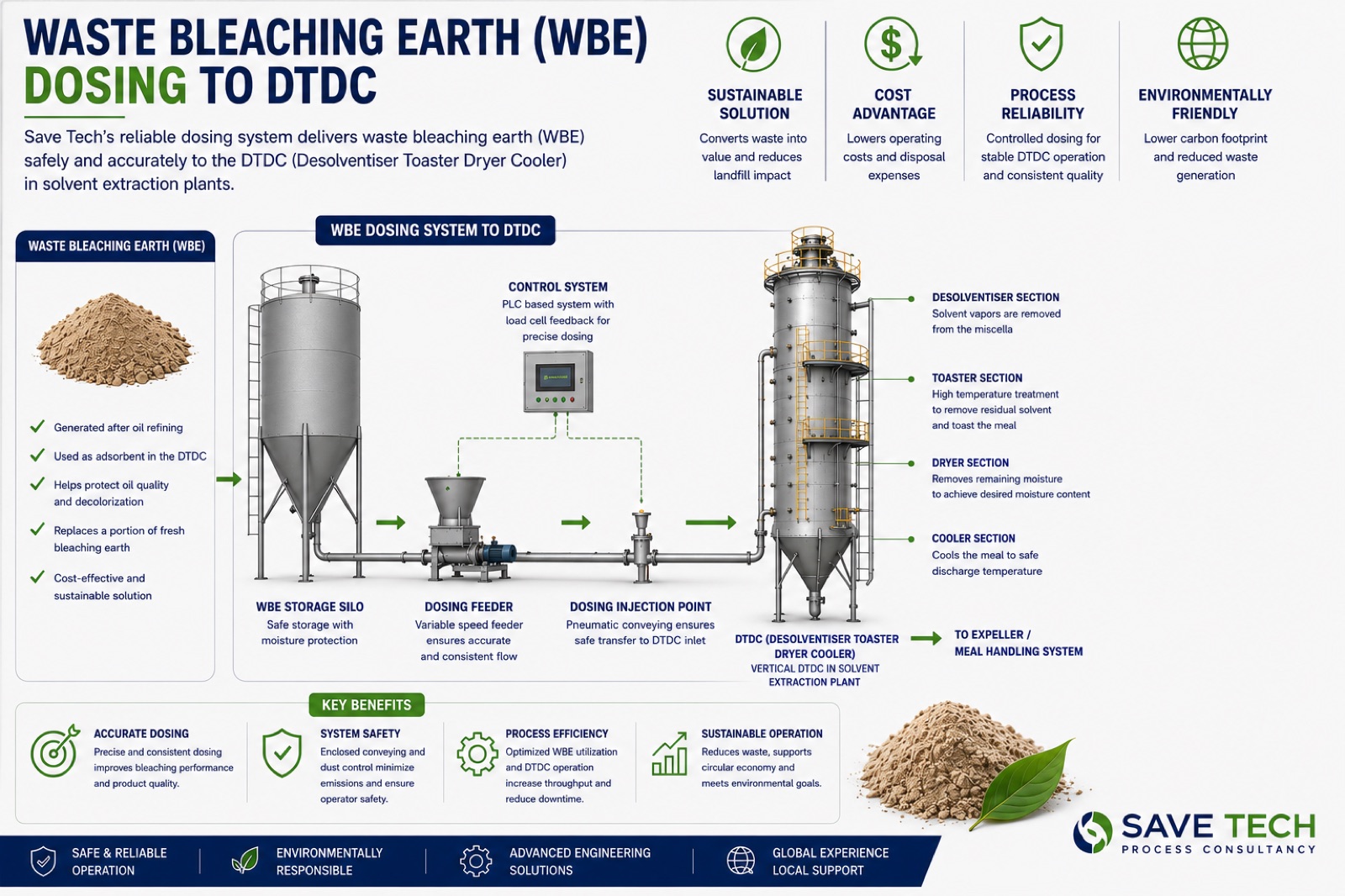
How the Dosing System Works
WBE Storage Silo
Safe intermediate storage of used bleaching earth with moisture protection, the buffer for continuous, controlled dosing.
Variable-Speed Dosing Feeder
A variable-speed feeder ensures accurate and consistent material flow, precisely matched to the DTDC throughput.
Pneumatic Conveying & Injection
Enclosed pneumatic conveying transfers the WBE safely to the dosing injection point at the DTDC inlet, with dust control for operator safety.
PLC Control with Load Cells
A PLC-based control system with load cell feedback continuously monitors and adjusts the dosing rate, for stable DTDC operation and consistent quality.
Integration into the DTDC
The material passes through the DTDC sections, desolventizing, toasting, drying, cooling, fully integrated into the existing meal production.
To Meal Handling
Downstream, the finished meal continues to the expeller / meal handling system, no change to the plant's product logistics.
A Controlled Stream Instead of an Uncontrolled Risk
Oily used bleaching earth can self heat and ignite when it accumulates uncontrolled. The Save Tech system turns it into a stable, monitored and fully documented process stream.
Conditioning and Stabilisation
The WBE is conditioned into a stable suspension before dosing. Suspension preparation, stabilisation and dosing logic are Save Tech proprietary process know how. Detailed operating values are established after technical assessment and laboratory verification.
Reduced Self Heating and Fire Risk
Controlled inventory and enclosed transfer prevent uncontrolled free accumulation. This materially reduces exposure to self heating and spontaneous combustion scenarios and supports the plant's fire safety procedures.
Interlocks, Permissives and Alarms
Dosing runs only under defined process conditions. PLC integration with permissives, alarms and safety interlocks keeps the DTDC stable at all times.
Batch Records and Traceability
Batch records, recipe control and production traceability document every dosed quantity. The result is a homogeneous, verifiable distribution in the final meal.
Key Benefits
- Elimination of disposal costs
- Improved plant profitability
- Accurate, PLC-controlled dosing
- Enclosed conveying & dust control
- Stable DTDC operation
- Circular-economy implementation
- Lower carbon footprint
- No major additional equipment
Save Tech's solution enables extraction plants to convert a disposal problem into a sustainable business opportunity while reducing environmental impact.
From Plant Data to Investment Decision
No investment amount, annual benefit or payback period is committed until plant data, oil analysis, regulatory position and integration requirements have been verified.
Data Collection
Operating quantities, WBE oil analysis, costs and current handling practices.
Site Assessment
WBE generation, collection, DTDC integration, automation and available space.
Preliminary Feasibility
Mass balance, capacity, CAPEX, OPEX, annual benefit and payback.
Official and Quality Review
Feed, environmental, HACCP and plant permit requirements.
Engineering and Implementation
Detailed engineering, installation, commissioning and performance verification.
Engineered to Comply with EU Feed Legislation
The use of used bleaching earth in feed production is governed by the EU Catalogue of feed materials, Commission Regulation (EU) 2022/1104, replacing the Annex to Regulation (EU) No 68/2013, based on Regulation (EC) No 767/2009. Save Tech's dosing system is engineered so that plants meet these requirements verifiably.
The 1 % limit for soya (bean) meal feed
The Catalogue permits soya (bean) meal feed to contain up to 1 % of the sum of used bleaching earth and filter aids. The PLC-controlled dosing with load cell feedback keeps the dosing rate continuously and demonstrably within this limit.
Integrated crushing & refining site
This content is only permitted for products produced at an integrated crushing and refining site. Save Tech's system is designed precisely for integration into such sites.
"Bleaching" as a defined process
The Catalogue defines bleaching, including the use of bleaching earth, as a recognised treatment process for feed materials.
Feed hygiene & good manufacturing practice
Enclosed conveying, precise dosing and continuous monitoring support good manufacturing practice under the EU Feed Hygiene Regulation, consistent quality, dust control and full traceability of the dosed material.
Corresponding entries with the same 1 % limit apply to rapeseed, sunflower, linseed, olive and maize germ meals (e.g. entries 2.14.6/7, 2.19.6/7, 2.8.4/5, 2.11.2, 1.2.19). The 1 % figure is a maximum content in the final meal, not a standard operating setpoint.
The FEDIOL industry declaration on the safety of used bleaching earth and used filter aids in meal feed and expellers (Ref. 13SAF195) describes the use of WBE in integrated plants and the material restrictions to respect. A plant specific legal and quality review is required before commercial operation.
Legal framework: Commission Regulation (EU) 2022/1104 (OJ L 177, 4.7.2022), Regulation (EU) No 68/2013, Catalogue of feed materials, Regulation (EC) No 767/2009, Regulation (EC) No 183/2005. View the regulation on EUR-Lex →
Downloads
All documents are in English.
Interested in this technology?
Tell us about your feedstock, capacity and site, we'll propose the right solution. On request we prepare an individual example calculation with clear analytical figures showing the expected profit and outcome for your plant.